
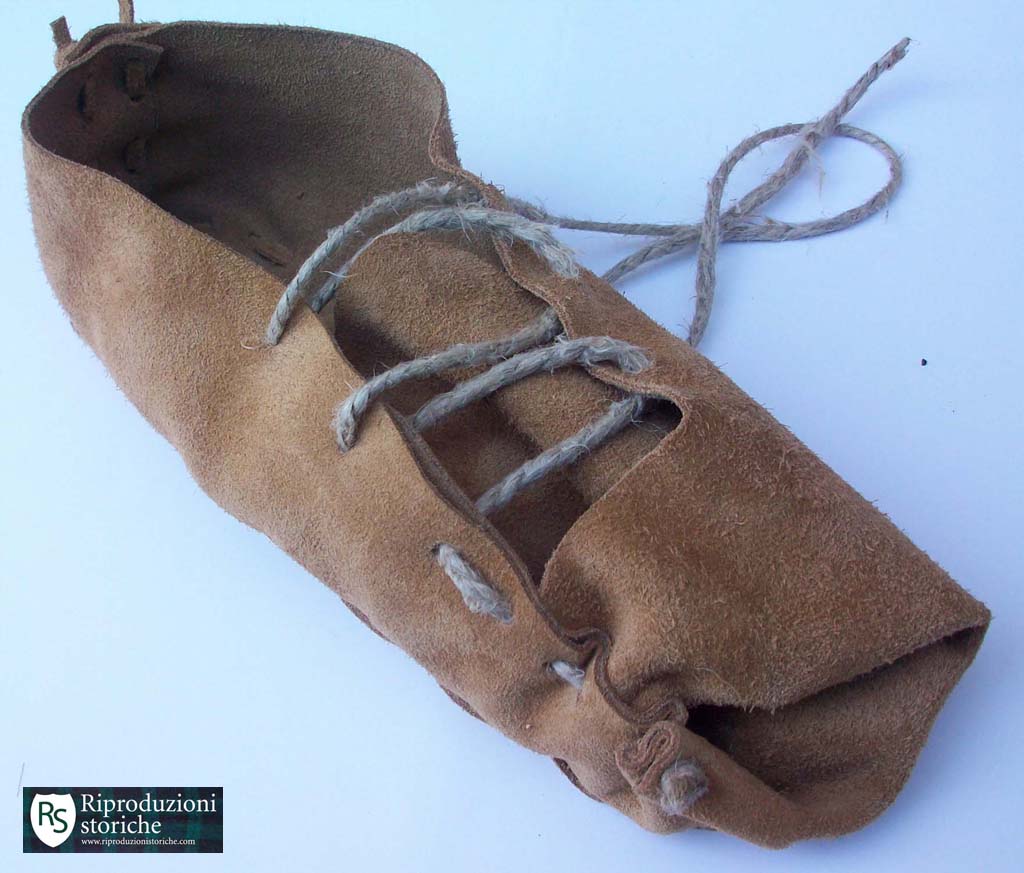
The shoe was made from a piece of natural hide, to which a sole cut from the same material was attached and sewn on with a leather thong.
The front part was folded over to form a kind of “pouch”, then holes were punched through which a hemp lace was threaded; as well as keeping the shoe closed at the front, it allows it to be tied around the instep. At the heel, as can be seen on the find, there is a closure also made with a leather thong.
The resulting shoe is fairly comfortable, apart from the fact that the lack of a thick, sturdy sole is very uncomfortable for modern people, especially on rough ground.
The folded-over front of the hide protects the toes and partly the instep from exposure to the outside environment, and needs no further stitching.
Despite its simplicity, it seems well made and functional, cleverly folded so as to be easy to make and practical at the same time.
Historical evidence
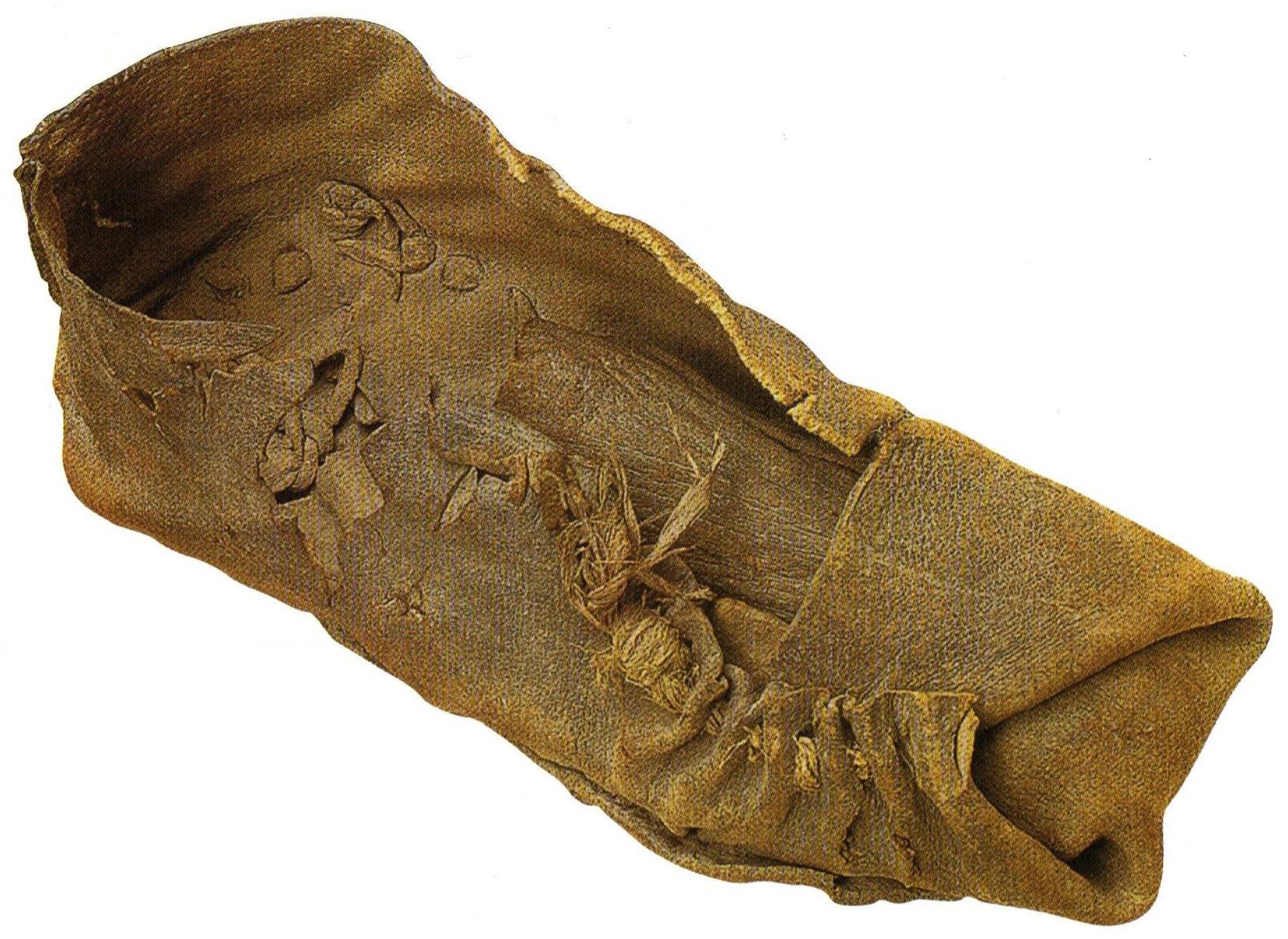
Dürrnberg salt mines, 6th-5th century BC, Salzburg Museum (Austria)
In one of the oldest rock salt mines in Europe, on the Dürrnberg mountain, it is still possible to walk through the same galleries in which the Celts, more than 2,500 years ago, first extracted salt.
Ever since the time of the Celts, salt has brought wealth and prosperity to those who owned it, thanks to its value as food but above all to its ability to preserve food; it is precisely to this last, but important, property that we owe the discovery of what are the very few finds of Celtic footwear preserved to date.
These few but extremely important finds, together with the decorations and bas-reliefs that have come down to us, have made it possible to reconstruct a picture of the range of footwear the Celts may have used over the centuries.