
Cisalpine viticulture was already linked to the use of the oak barrel in the later Iron Age, as attested by the sources from the 2nd century BC onwards and very clearly in the funerary reliefs of the Roman period.
The ancient writers’ descriptions of the enormous ageing barrels of Cisalpine Gaul (“larger than houses”, Strab. V, 12) show how these wines – probably drunk neat or with little added resin, in marked contrast to the trends of Mediterranean winemaking and even of the Ligurian area of southern Piedmont – were linked to the Celtic habit of drinking strong, pure red beer (cervisia), which required considerable oxygenation.[1]
Latin writers, used to the terracotta containers that travelled around the Mediterranean, were struck by this kind of vessel for storing and transporting drinks, so much so that “in the Alpine regions,” Pliny notes, “they are enclosed in wooden vessels reinforced with hoops” (N.H.XVI,75)[2] (they are the same today, except for the detail of the hoops, which back then were made of willow, not metal[3]). Sucellus himself, the Gaulish god of wine, whose name means “the good striker”, is the god of wine because he hammers the barrels in which it is kept: indeed he is depicted with a kind of mallet, which is also very similar to that of the Etruscan Charun figures.[8]
The Greeks, Etruscans and Romans generally stored wine in amphorae, keeping it very full-bodied and resinated, and drank it heavily watered down, sometimes warm, whereas the Celts and Germans drank wine neat, neither resinated nor watered down. Consequently the Mediterranean world tended to use wide cups as drinking vessels (such as the kylix or the kantharos), which allow the strong aromas of the drink to be better appreciated through the sense of smell, while barbarian Europe preferred to drink wine from tall, narrow beakers, which reduce evaporation. The medieval and modern way of drinking wine descends from the slow conversion of the Roman world to “barbarian” tastes, already during the Imperial age, and this is also why, even when the original grape varieties can be identified, it is not easy to imagine the true taste of the wines of the classical world. From the later Iron Age onwards, the presence of wine sickles in graves in the provinces of Novara and Verbania (Dormelletto, Oleggio and Ornavasso), as an explicit symbol of the ownership of vineyards and not as a mere working tool, documents the importance, already in pre-Roman times, of a production which, not by chance, goes hand in hand with the exceptional spread, as a container, of a table vessel (the “spinning-top flask”) whose typical shape is strikingly similar to that of a modern decanting bottle. Indeed, between the 2nd century BC and Romanisation, the spread of this typical wine container on both sides of the Ticino is clear; it derives from the Golasecca “bottle vase” tradition, not without influences from forms typical of northern France, which spread through the necropolises following the Gallic invasions of the 4th century. The proof that the spinning-top vase was used as a wine container comes from the inscription on one of these finds among the grave goods of tomb 84 at Ornavasso, datable to the first quarter of the 1st century BC: Latumarui Sapsutaipe uinom natom (“to Latumaros and Sapsuta a nantos – a cup or vessel or measure of capacity, from a Celtic term meaning riverbed, basin, valley – of wine”).[1]
It is likely that the wine carried in amphorae from
Greece to Adria or Spina, and from there along the river routes as far as the Forcello, did not stop at that site but, after being decanted into containers better suited to overland transport, e.g. wooden barrels, travelled further on, as far as the Golasecca Celts and those of central Europe. This would explain the spread among these peoples too of Attic pottery and Etruscan bronze vessels, which made up the set for preparing and consuming wine during the banquet.[6]
From the 3rd century onwards, literary, iconographic and archaeological sources attest a more widespread use of barrels for the wine trade than in the past – that is, of a type of container that survives only in very particular depositional conditions. The data provided by wine amphorae would therefore not reflect – at least from a certain point onwards – the whole of the wine trade, but only the transport of those products that used, or continued to use, amphorae.[4] From Strabo we learn that wine from Cisalpine Gaul was carried beyond the Alps from Aquileia, in small barrels loaded on wagons (Strabo V, 1, 12).[7]
In the Picene area, no Picene amphorae of the late antique period have been identified so far; it is therefore likely, as A. Tchernia has suggested, that in this period ceramic containers were replaced by barrels, which are moreover well documented in the iconographic sources of the Adriatic area.[5]
 |
 |
|
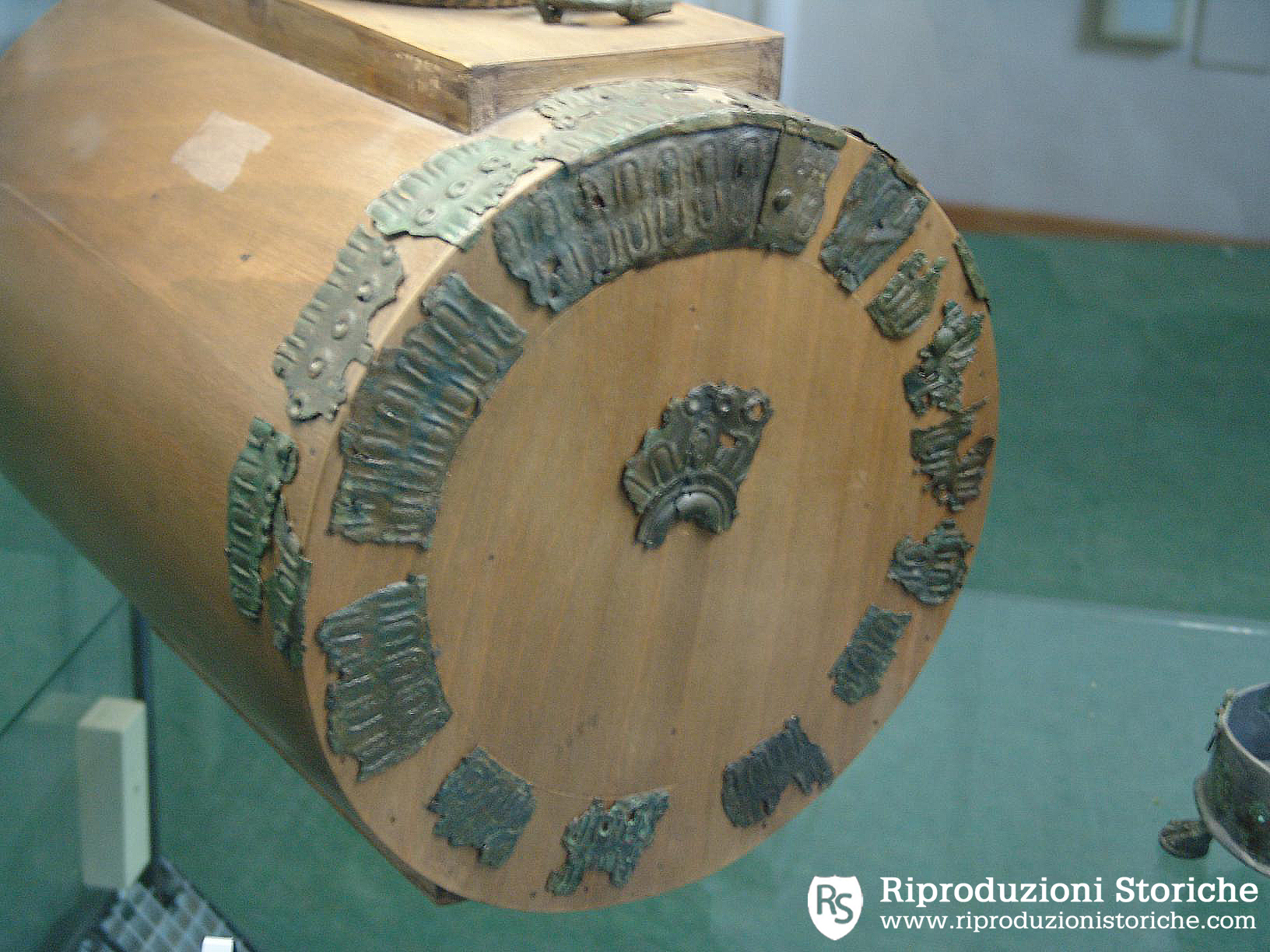
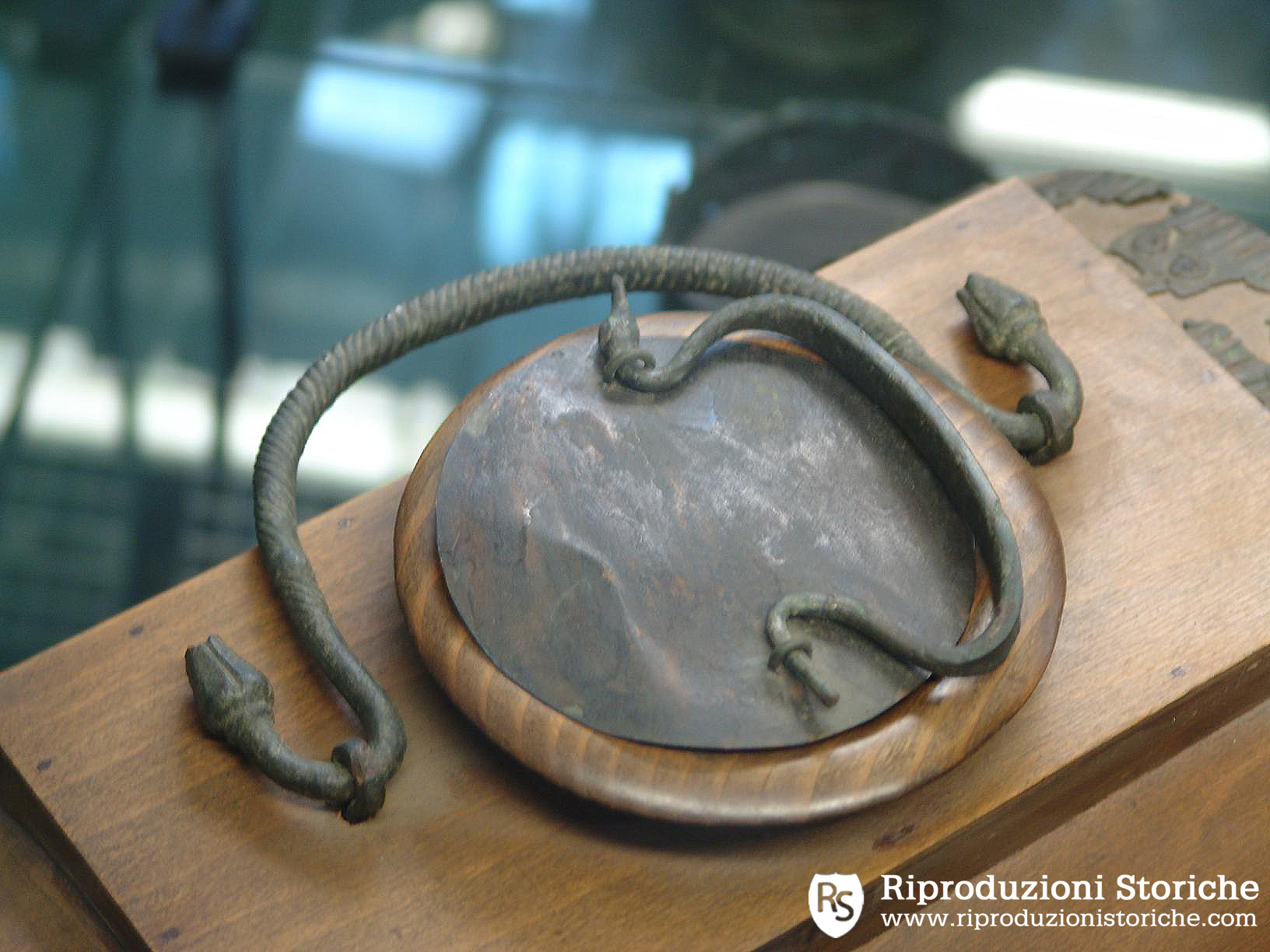
Tomb 2, small wooden barrel (reconstructed) with embossed bronze covering, feet, lid and handle, 4th century BC, Archaeological Museum, Ancona. |
|
 |
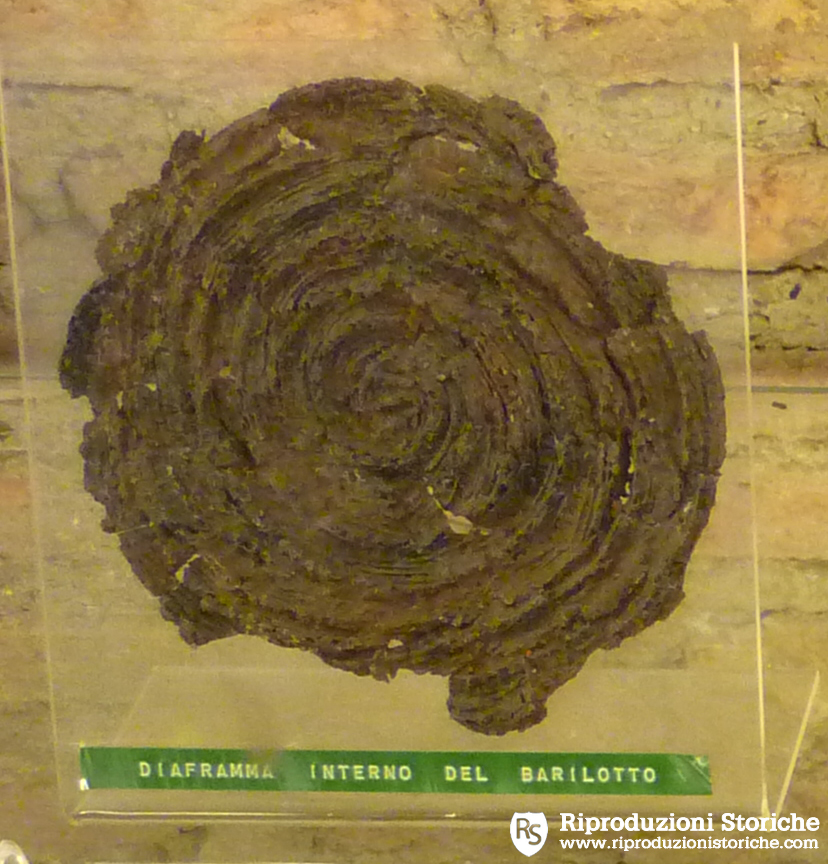 |
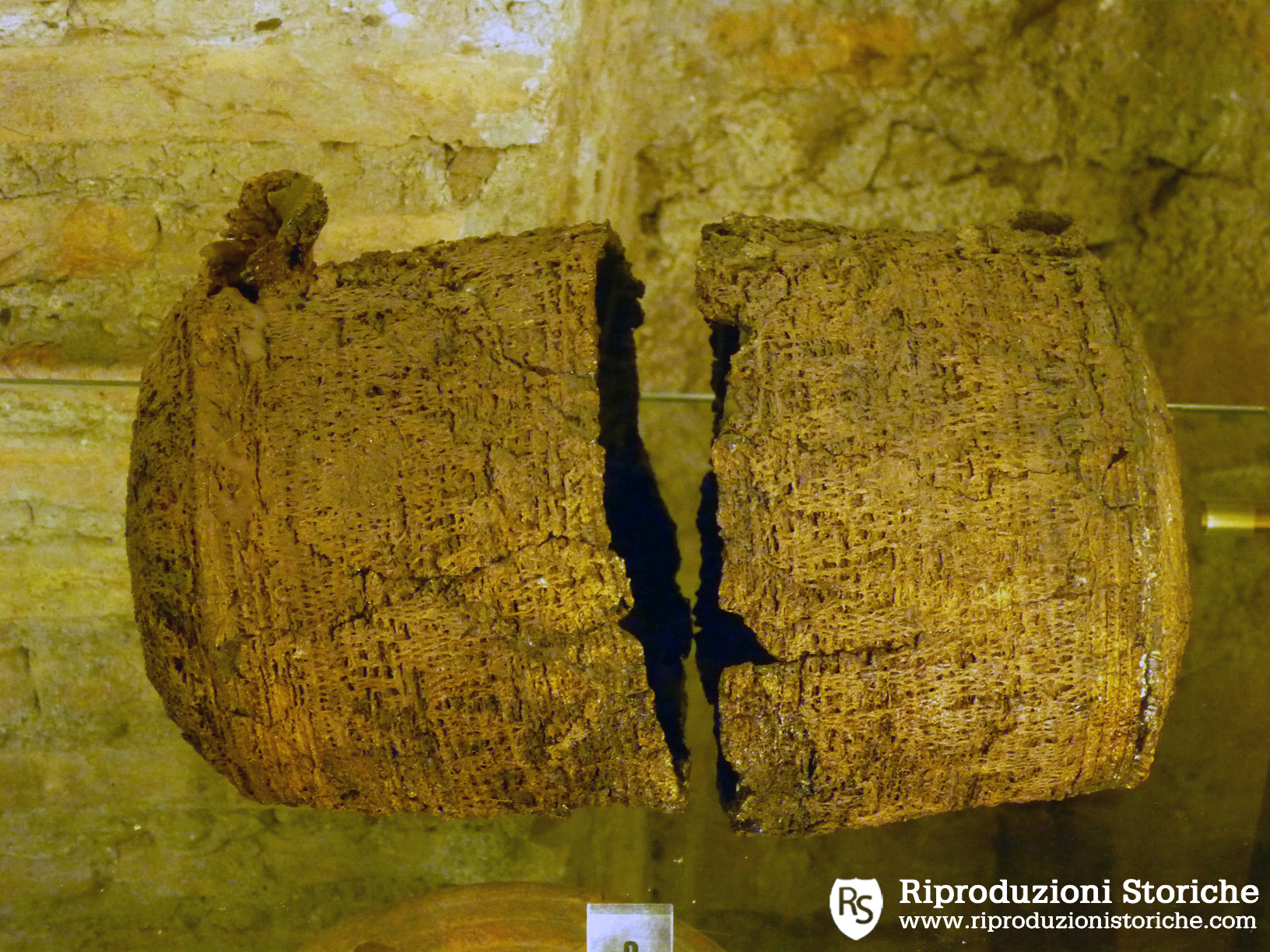
| Tomb 170, Banditaccia necropolis – Bufolareccia, 6th century BC, Archaeological Museum of Cerveteri. Small wooden barrel covered in wicker, with an internal wooden partition dividing the barrel into two parts so that two different liquids could be stored. | |
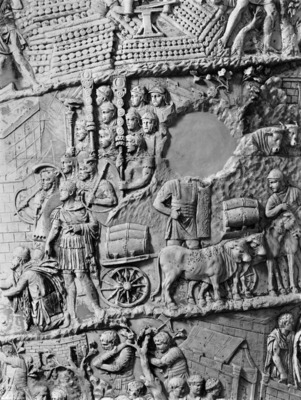 |
| Trajan’s Column, scene of barrels being transported on wagons drawn by oxen and mules, escorted by legionaries |
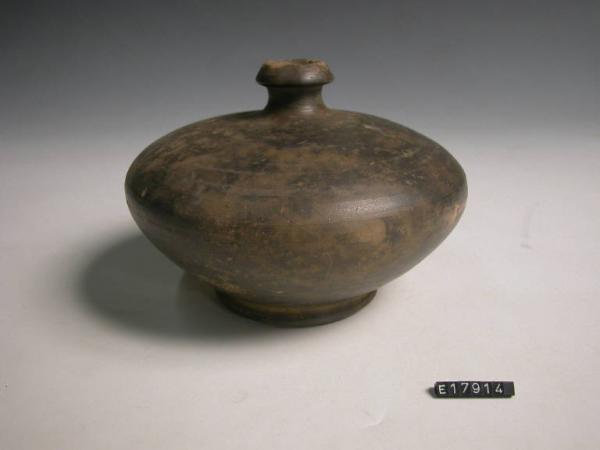 |
| Spinning-top vase, Golasecca culture, 4th-3rd century BC, Archaeological Museum of Como |
Bibliography
[1]L’alimentazione nell’Italia antica [http://www.beniculturali.it/mibac/multimedia/MiBAC/minisiti/alimentazione/]
[2]La grande storia del vino; Alfredo Antonaros; Edizioni Pendragon; 2000
[3]I tempi alimentari del Mediterraneo: cultura ed economia nella storia alimentare dell’uomo, Volume 1; Fausto Cantarelli; FrancoAngeli; 2005
[4]Le anfore di età imperiale del Mediterraneo occidentale; Clementina Panella; in Institut des Sciences et Techniques de 1’Antiquité; Céramiques Hellenistiques et Romaines
[5]Le vin de l’Italie romaine. Essai d’histoire économique d’après les amphores; André Tchernia; Rome: Ecole française de Rome; 1986
[6]La civiltà di Golasecca: i più antichi Celti d’Italia; Raffaele C. De Marinis, Dipartimento di Scienze dell’Antichità, Università degli Studi di Milano (restricted document)
[7]Rinvenimenti anforacei nel Trevigiano: tipologie e commerci; Silvia Pascale; Gruppo Archeologico Trevigiano
[8]I celti e il vino; Filippo Maria Gambari; transcript of a lecture held at the Chiostro di San Sebastiano, Biella; 1998