
Armour made of interlinked iron rings forming a metal “fabric” is one of the most widely used forms of protection in history.
Introduction
The invention of mail cannot be attributed with certainty to a specific culture or period, since on the basis of the evidence that has come down to us its origin is not easy to establish; some say it can be attributed to the Celts, according to what Varro wrote in “De Lingua Latina”: “Lorica, quod e loris de corio crudo pectoralia faciebant; postea subcidit gallica e ferro sub id vocabulum, ex anulis ferrea tunica.” (which translates roughly as: “Lorica once meant the leather protection worn on the chest, whereas today it means the protection made of iron rings, of Gaulish origin.”).
One of the oldest finds seems to come from Hjortspring, in Denmark, 4th century BC, in the famous Hjortspring boat, which besides containing fragments of iron mail also carried a large number of weapons, including spears, swords, helmets and shields.
Around the 3rd century BC it seems to make its first appearance in central Europe: the fact that one of the earliest finds (in iron) came precisely from a Gaulish necropolis at Ciumesti, in Romania, thought to have been in use from about 230 to 130 BC, perhaps leaves no doubt that it was the Gauls who introduced it to Europe.
Bronze fragments have been found at Leiden, in the Netherlands, assembled in a 1-4 pattern, with 4 rings forged already closed and a central one forged open and then closed afterwards, once it had been linked to the other 4.
Although mail was one of the most widely used forms of protection in the military history of the world (before the advent of firearms), very little is known about its makers and the construction techniques they used.
First of all, it is important to consider that, unlike many other types of armour, a mail shirt can adapt to different builds (whereas plate armour, for instance, has to be made to measure), so it is plausible to think that it was handed down through many generations, probably undergoing continual modifications and refitting, which not only ensured proper maintenance but also allowed the armour to be tailored to the wearer’s needs. Some scholars have identified greater wear of the rings in the armpit and shoulder areas, which in their view is due precisely to the greater friction of ring against ring caused by use over hundreds of years; the alleged presence of newer “patches”, i.e. clearly distinct areas of the mail made up of more recent-looking rings, would also be evidence of repairs carried out even a long time apart.
Another important factor to take into account is its high cost of manufacture, which therefore encouraged this passing from hand to hand.
Little is known about the construction process, but it is reasonable to assume that the technique was the same as the one used in the Middle Ages, since in many cases these techniques are found to have persisted even for millennia, with minimal variations. Moreover, since mail shirts could not be signed with the maker’s mark (for the obvious reason that there is no suitable surface), no identifying marks of their makers have come down to us either, which could otherwise help to catalogue or date the finds more precisely (as is done, for example, with pieces of artillery, medieval armour or swords).
Among the Celtic peoples it is thought to have been the prerogative only of the privileged few who were wealthy enough to afford the raw material and the long work needed to make it: the scant evidence, besides the rare finds that have come down to us, suggests that it was not widespread until the end of the 3rd century BC, when the Roman Empire, which was undergoing major reorganisation in military matters, began to adopt it on a large scale, probably after encountering it in some battle against Gaulish tribes. The Roman industrial machine began to produce hundreds of examples, introducing this protection onto the battlefield on a far greater scale than had ever been done before, and calling it lorica hamata.
In this regard Polybius speaks of the lorica hamata as a protection available only to those with a high enough income to afford it, in place of other “lower-category” protections.
Its effectiveness is borne out by the extensive use that man made of it in battle, eventually extending its coverage beyond the torso to the whole body. With the advent of firearms mail was soon abandoned, remaining in use only among very few military corps, such as the Polish hussars until the 17th century or Afghan troops in the last century.
The first Iron Age blacksmiths who set about making a mail shirt were certainly faced with a very difficult and demanding task, requiring all their skill and months of long work. However, considering how widespread it became in the following centuries, it is plausible to think that within a few centuries of its appearance in Europe there may already have been specialised workshops in which the work was divided among various craftsmen, with consequent time savings and a guarantee of good quality.
Analysis of the finds and construction hypotheses
Six bronze rings (from Leiden) with no subsequent closure (i.e. made already closed) have been analysed under the microscope and appear to have been “punched” out of a sheet. Using cutting dies of different diameters (depending on the inner and outer diameter of the ring, and therefore on the “thickness” required), the rings were made from a sheet; other iron rings (from Caerleon) with the same characteristics were also studied under the microscope, and a series of experiments showed that bronze rings, and iron ones too, could be made by die-cutting (or punching) and then finished on a cylindrical former to even out their characteristics and remove burrs. The set of already-closed rings obtained in this way (called “solid” rings) was assembled with open rings, which were then closed afterwards by welding or riveting. This method not only saved time during assembly, but probably also during the making of the rings themselves.
However, other studies on the subject have offered new food for thought, showing on the basis of the analyses carried out that the rings could not have been made already closed (i.e. punched from a sheet); according to Dr. Stephen V. Granscay, curator of arms and armour at the Metropolitan Museum of Art in New York, these rings were made from wire and then welded to obtain a seamless closure, without any kind of rivet.
As for making the wire, assuming one started from an ingot or a semi-finished iron bar, the first step was to hot-work the metal to form a wire which, still too thick to be used, was passed through a draw plate, that is, through a series of progressively smaller holes made in a small steel plate. The quality of the metal is thought to have been high, since the more homogeneous its structure (and therefore free of slag), the lower the risk of breakage.
The oldest evidence for the use of this method comes from the finds of a few Roman-period draw plates, for example at Vindolanda (England) and Altena (Germany). A common feature of these two draw plates, considered among the oldest iron ones ever found, is the size of the holes: ranging in diameter from 2 mm to 10 mm, they seem too large to allow wire drawing; in fact it is thought that above 2 mm drawing is very difficult because of the great force that would have to be applied.
 |
| Roman draw plate from the Roman fort of Vindolanda (England), occupied from AD 85 and in use for over 5 centuries (above). Another Roman draw plate from Altena (Germany), dated ??? (below) [photo source: internet] |
There is actually a further “emblematic” find of what might appear to be a draw plate, at Isleham, in Cambridgeshire, England, dated to the Late Bronze Age; however, given the irregularity of the holes and the great differences in their diameters, it is legitimate to doubt that it really was a draw plate.
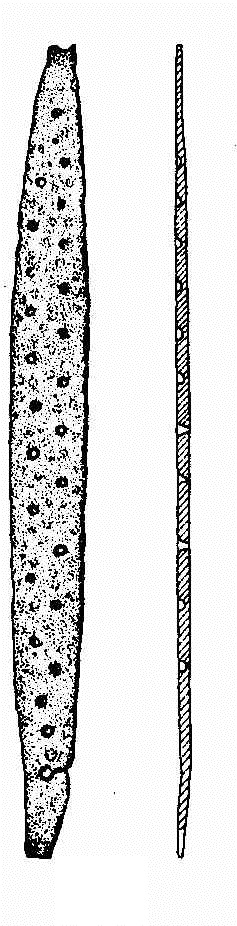
This method is, however, later attested in the 9th and 10th centuries, thanks to the fortunate find at Morgedal, in Norway, where an entire chest, probably belonging to a Viking blacksmith, was extraordinarily well preserved and yielded a large number of tools, weapons and various implements, including two draw plates, testifying to the persistence of this technique for hundreds of years after the earliest known draw plates.
 |
 |
 |
| Various objects, in particular draw plates, found at Morgedal, Norway, 9th-10th century AD [photo source: internet] | ||
Over the centuries the use of draw plates has not changed, and even today they can be bought in shops specialising in jewellery-making supplies.
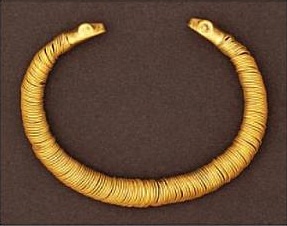
According to some scholars, the iron and bronze rings analysed show a surface “marked” by lines caused by the wire passing through a draw plate. By way of example, the photos below show a collar made of gold wire and a photomicrograph of it, which clearly shows the surface lines discussed above.
 |
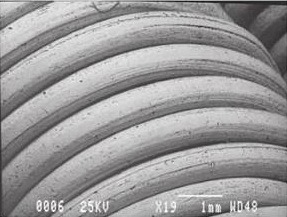 |
| Romano-Egyptian gold collar showing traces of wire drawing. | |
Going back to the iron wire mentioned above, still too thick, it was pulled with the aid of pliers or wooden windlasses through the holes of the draw plate, which evened out its surface and progressively reduced its diameter until the desired size was reached. At this point the wire was probably wound around a round bar (called a mandrel) of the same diameter as the desired rings, forming a coil, which was then cut lengthways with a chisel, separating all the rings. The two ends of each small ring were brought together and joined by welding or with a small pin (rivet), so that each ring was “linked” to 4 adjacent ones, forming a “fabric” with a very precise weave, shaped so that it could be worn.
The high cost in terms of raw materials and labour makes it easy to suppose that each mail shirt might be handed down from father to son, and thus reused for entire generations or until it was lost, for example if its owner died in battle. In that event it passed to the enemy as a trophy or as spoils of war.
Although not directly related to the making of mail shirts, it is interesting to consider another technique for making wire: spiral twisting.
This technique, used mainly on precious non-ferrous metals (gold, for example), consists of cutting a thin strip of metal from a sheet and then twisting it on itself to form a very tight spiral which, once its surface has been finished, becomes round in section (see photo below).
 |
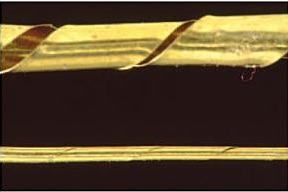 |
| Making a wire from a square or flat bar using the technique of spiral twisting on itself. | |
 Roman gold chain from New Grange, Ireland, made with the technique discussed above.
 Photomicrograph of the previous chain: the seams of the windings can be clearly seen.
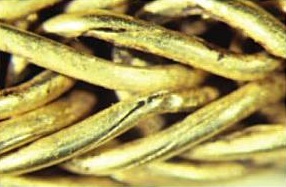 Another example of wire made with the technique described above, from a gold chain of a Parthian collar of the 1st-2nd century AD.
The lorica hamata
This type of protection, made of interlinked iron rings (hami = hooks, rings), provided an excellent defence against both cuts and thrusts, while at the same time allowing great freedom of movement, at the expense of weight (up to 10 kg and more). Many depictions show the lorica hamata made up not only of plain ring mail but also of an additional element, calledhumeralis, i.e. an extra layer which, according to Connelly, increased the protection on the shoulders, since in a tight phalanx formation (such as the Roman one) most of the most dangerous blows came from above, striking the shoulders, the upper back and the head.
Connelly identifies two types of humeralis: the first, with a shape and fastening system comparable to those of the Greek thorax, consisting of two shoulder pieces attached to the mail at the back and fastened at the front with two hooks; the second consisting of a sort of short cape draped at the front, covering the top of the shoulders. The first “style” is believed to be of Greek origin and the second of Celtic origin.
A further hypothesis is that ring armour, once introduced into Europe by the Celts, was modified by the Romans to suit “local” fashions too, dictated precisely by the presence of the humeralis on the Greek thorax; the humeralis would thus have changed from the “Celtic” model to the “Greek” one.
The strength of iron mail has been debated at enormous length, and nowadays countless experiments have been carried out on its resistance (above all against arrows), both by authoritative scholars and organisations and by others. In the popular imagination, ring mail tends to be considered of little use, especially against arrows, particularly those with certain point shapes; in reality some experiments and written sources have at times shown the opposite, demolishing many of the tests and hypotheses put forward in this respect. Most of these experiments, in fact, are carried out without considering many important factors, which significantly change the final outcome in favour of the lorica hamata.
Some of the common errors are, for example, the use of unriveted mail, contrary to the finds, in which all (or almost all) the mail fragments consist of riveted and solid rings (made by die-cutting or welding); in other cases the original thicknesses, the quality of the metal or the diameter of the rings were not respected, so the “sample” mail was of lower quality and had a much looser weave than the originals.
The absence from the tests of padded protection (subarmalis), which together with the iron ring mail formed a much more resistant structure, and for which there is abundant evidence well beyond the ancient period, has also been, for many, a source of error in their experiments.
Some historical sources, too, tell of victories and glorious resistance of iron ring mail (combined with good padding underneath) against arrows (author’s note: I have tried to provide translations that are as accurate as possible, to the best of my abilities):
– Colmariense Chronicon (1398): […]camisiam ferream, ex circulis ferreis contextam, per quae nulla sagitta arcus poterat hominem vulnerare[…] which translates as (the men-at-arms wore) “… an iron shirt, woven of iron rings, through which no arrow shot from a bow could wound a man”.
– Chronicle of Lanercost (1272-1346): at the battle of Byland (1322), Scrymgeour, Robert the Bruce’s standard-bearer, pulled a longbow arrow out of his arm, which was left unhurt thanks to the mail hauberk (he was wearing).
– The Alexiad (c. 1148): regarding the battle of Dyrrhachium (1108), the author recounts that “the Byzantines resorted to shooting arrows at the Franks’ horses, because against the soldiers’ iron ring mail armour they were ineffective”.
Historical evidence
There are many sources attesting to the use and characteristics of the lorica hamata; some of the most authoritative are cited below:
 Warrior of Vacheres, 1st century BC [photo source: internet]
 Altar of Domitius Ahenobarbus, 113 BC [photo source: internet]
 Pergamon Altar, 2nd century BC [photo source: internet]
 Arch of Orange, 1st century BC [photo source: www.archart.it]
 St. Albans, Great Britain, c. AD 55. [photo source: internet]
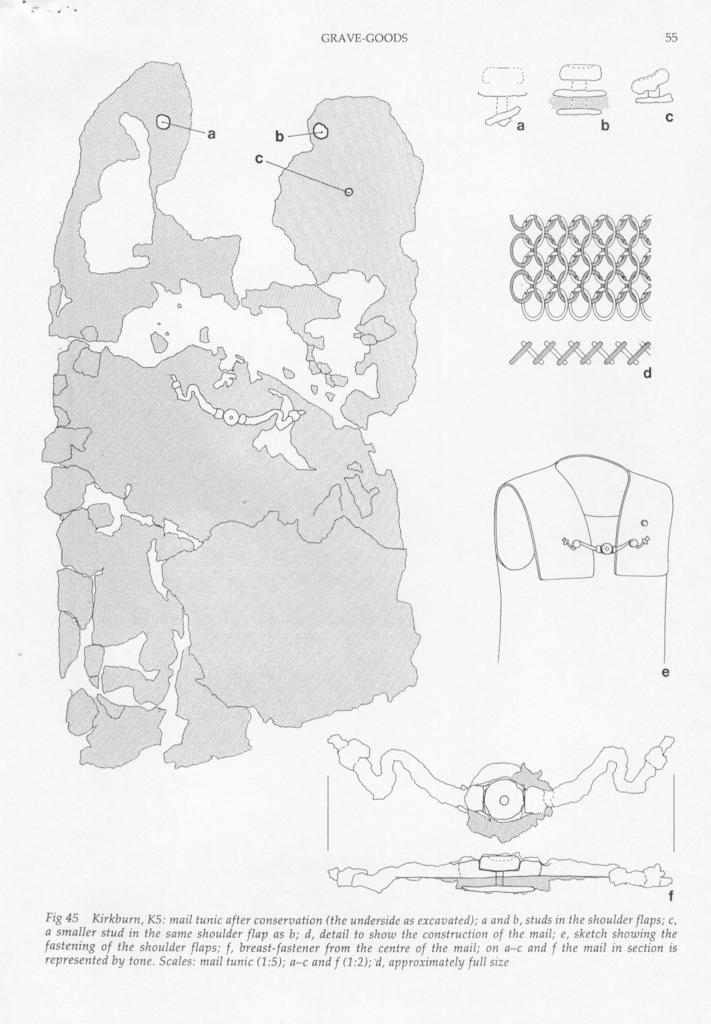 Kirkburn, Yorkshire, Great Britain, 3rd-2nd century BC [photo source: internet]
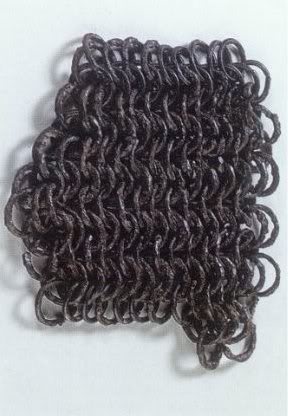 Ciumesti, Romania, 3rd century BC
Almost all the finds of ring mail fragments or metal wire are listed in the table below:
| Austria | Carnuntum | R |
| Bulgaria | Jankovo | F |
| former Czechoslovakia | Horny’ Jatov | F |
| Zemplìn | F | |
| Denmark | Barsbø | R |
| Brokaer | R | |
| Hjortspring | F | |
| Neder-Jerstal | R | |
| Vimose | R | |
| France | Aubagnan | F |
| Boe | F/R | |
| Chassenard | R | |
| Lyon | R | |
| Strasburg | R | |
| Germany | Berlitt | R |
| Bockhorn | R | |
| Camin | R | |
| Dahlhausen | R | |
| Cheine | R | |
| Dessau- Grosskühnau |
R | |
| Gross Gartz | R | |
| Hagenow | R | |
| Hemmoor- Warstade |
R | |
| Issendorf | R | |
| Kasseendorf | R | |
| Kemnitz | R |
| Kiel | R | |
| Künzing | R | |
| Mainz | R | |
| Putensen | R | |
| Saalburg | R | |
| Sörup | R | |
| Süderbrarup | R | |
| Thorsberg | R | |
| Weissenburg | R | |
| Wasterwanna | R | |
| Wollenrade | R | |
| Zugmantel | R | |
| Greece | Somothrace | R |
| Italy | Aquileia | R |
| Pompeii | R | |
| Luxembourg | Weiler-la- Tour |
R |
| Netherlands | Den Haag | R |
| Fluitenberg | R | |
| Ouddorp | R | |
| Vechten | R | |
| Zwammerdam | R | |
| Poland | Komoròw | R |
| Mlodzikowo | R | |
| Opatow | R | |
| Witaszewice | R | |
| Zadowice | R |
| Romania | Cetăţeni | F |
| Ciumesti | F | |
| Poiana | F | |
| Popesti | F | |
| Răcătău | F | |
| Radovanu | F | |
| Sweden | Gränby | R |
| Oeremölla | R | |
| Switzerland | Tiefenau | R |
| England | Baginton | R |
| Baldock | F | |
| Caerleon | R | |
| Carlingwark Lock |
R | |
| Castleheaven, Kirkdbt |
R | |
| Chesters | R | |
| Colchester | R | |
| Housesteads | R | |
| Kirkburn | F | |
| Lexden | F | |
| Maiden Castle | F/R | |
| Manchester | R | |
| Newstead | R | |
| St. Albans | R | |
| Stanwick | F | |
| Woodeaton | R |
key: R: Roman period, F: Iron Age
[source of the table data: Journal of Roman Military Equipment Studies 4, 1993]
Conclusions
This article aims to bring to the reader’s attention a series of iconographic sources and scientific and experimental findings, in order to better outline the origin and construction technique, the development, the spread and, more generally, the use of what is, without exaggeration, one of the most functional and widespread forms of body armour ever invented by man over the centuries.
From the 4th-3rd century BC until the advent of firearms (but with rare examples up to the 20th century), man made use of it, reworking its shape and adapting it to his military purposes and sometimes to the fashions of the period, while keeping its functionality and construction technique almost unchanged.
I apologise if at times a bibliographical reference is not correctly framed, if some translations are inaccurate or if there are errors of any other kind.
Historical sources
– Varro, De Lingua Latina, Book V, 24, 2.
– Polybius, Histories, Book VI, 23, 15.
– Anna Comnena, The Alexiad, XIII, 8.
– Sir Herbert Maxwell, The Chronicle of Lanercost.
Bibliography
– Manuale di oreficeria e di lavorazione dei metalli, by Tim McCreight, p. 50.
– The Dacian Stones Speak, by Paul Lachlan MacKendrick, p. 52.
– The History and Evolution of Wiredrawing Techniques, by Brian D.Newbury and Michael R. Notis, p. 33.
– Armi e arte : un viaggio per musei, chiese e castelli alla ricerca di armi antiche, alla scoperta di cose belle, by Paolo Pinti.
– Fulgentibus armis: introduzione allo studio dei fregi d’armi antichi, by Eugenio Polito.
– Examination of mail armor links from the Metropolitan Museum of Art, by J. R. Vilella.
– Folly Lane (Verulamium): The Mail Shirt by B. J. Gilmore.
– Scientific investigation of copies, fakes and forgeries, by Paul Craddock, pp. 370, 376, 377, 379.
– Greece and Rome at War, by Peter Connolly.
– The Armourer and His Craft, by Charles John Ffoulkes.
An interesting article written by Dan Howard, very well done, which I recommend reading (in English), is available here:http://www.myarmoury.com/feature_mail.html#mark74