
Unhardened C70 steel blade, 3 mm thick, 23 cm long, 5 cm wide at the forte, with a 5 cm tang fixed by 4 iron rivets. Oak grip, 13.5 cm long.
The proportions were taken from the photograph of the find, and the length was estimated by eye on the basis of observing the original find. Looking at the find, I noticed that although the blade is fairly intact, the tang is extremely short: this may have been caused by greater deterioration and therefore the loss of most of it; however, I considered the possibility that the original knife was deliberately given a very short tang, a hypothesis also supported by the fact that there are as many as 4 rivets fixing the blade to the wooden grip.
To fix a very long tang (as long as the grip, for example), 2 rivets placed at either end would have been enough; in this find, however, there are 4 rivets and, above all, they are all concentrated in the front part of the grip, including the part where the blade is thicker.
This feature can also be seen on other knife finds in the same museum (see photo below), which led me to think that the grip was not a full tang, but was nonetheless firmly secured to the blade thanks to the 4 rivets concentrated in the front part.
The reproduction made with these features proved the sturdiness of the hypothesised type of fixing: indeed, once secured with the iron rivets, the two wooden grip scales turned out to be very firmly anchored to the blade, without any “play”.
The context in which the knives were found makes it easy to suppose that they were tableware rather than weapons of war, since they were found together with other objects such as spits, gridirons and tableware vessels.
Historical evidence
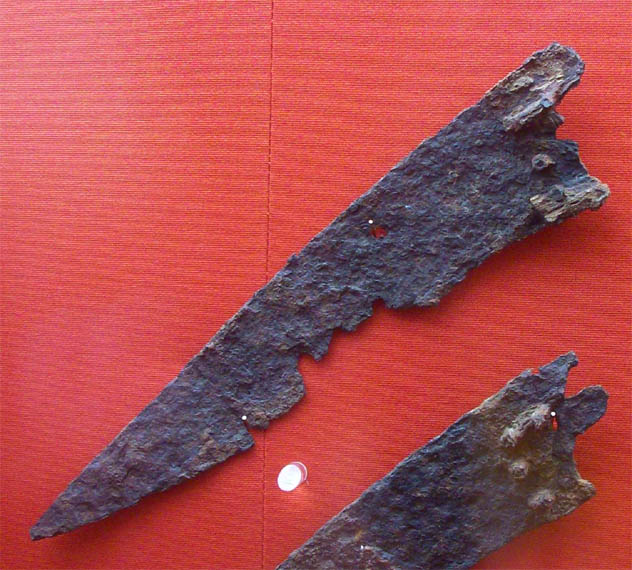
Grave 39, necropolis of Montefortino d’Arcevia, Archaeological Museum of Arcevia (AN)