
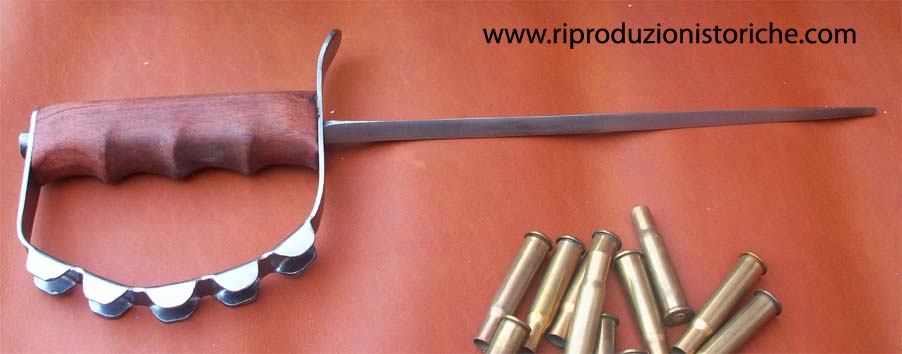
The US Model 1917 trench knife, issued to the United States Army in the First World War, is a dagger with a triangular-section blade and the special feature of a built-in knuckle-duster, made in two different types: “knobbed” or “flanged”.
A terrible weapon used in hand-to-hand combat in the trenches (hence its name), it could easily pierce the enemy’s body and clothing thanks to the shape of its blade: having no edge, and therefore unable to cut, it could pierce any layers of fabric, thus opening a way through to the enemy’s body, where it caused a wound that was harder to stitch than an ordinary cut. In front of the fingers, the grip carries a knuckle-duster that was also used to strike the enemy, made with pyramid-shaped points or with a jagged rim.
Despite its great offensive potential, this knife was later replaced by a new model, the Mark I Trench Knife, which was more versatile and had a cutting blade, so it could be used not only for combat but also for everyday tasks requiring a sharp blade.
Blade: triangular section with 6 mm sides at the forte, 220 mm long, in C70 steel.
Grip: made of American walnut, ergonomic, with “flanged” type guard and knuckle-duster in iron, 120 mm long, full tang peened over an iron ferrule at the end.
Historical evidence
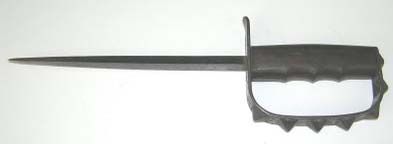
Trench knife with “knobbed” type guard
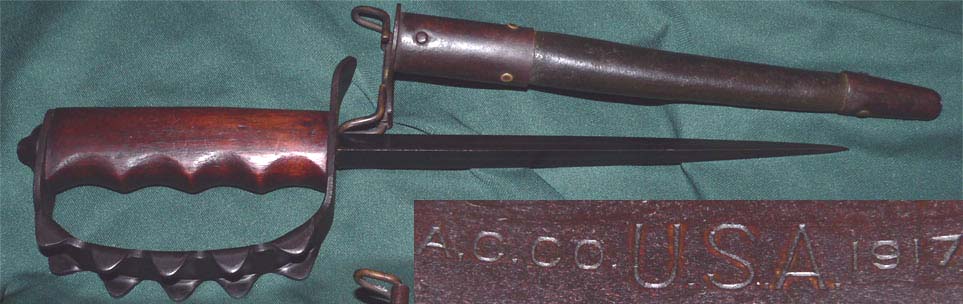
Trench knife with “flanged” type guard
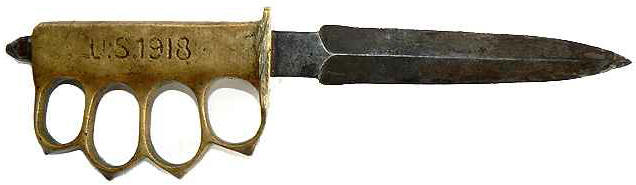
Mark I Trench Knife