
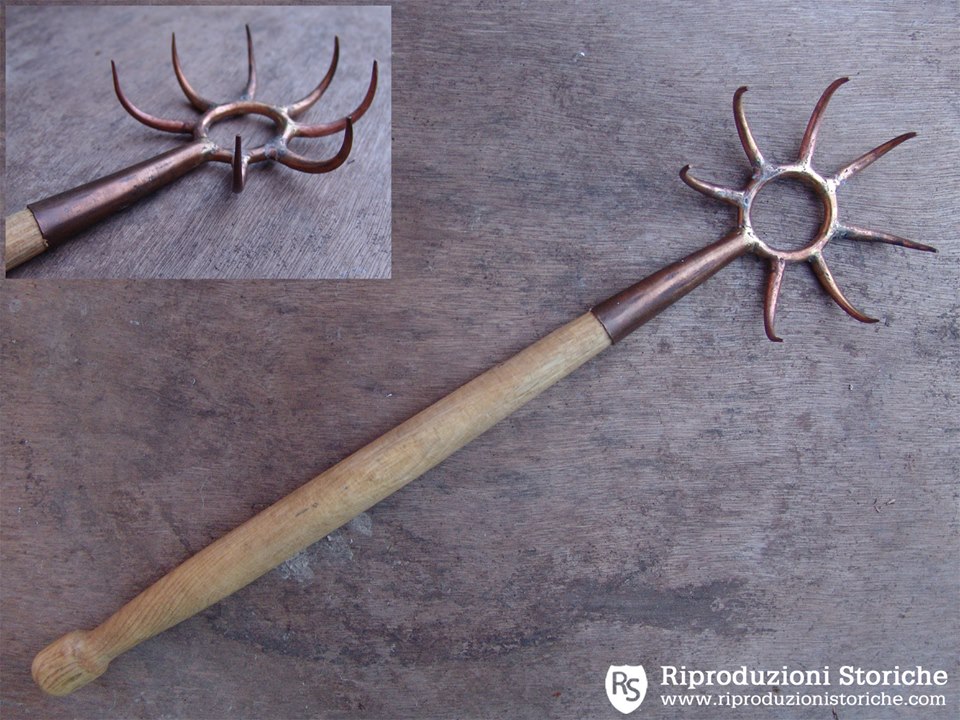
Flesh hook or kreagra, a bronze tool with seven inward-curving hooks (prongs), fixed to a socketed handle fitting by means of a ring. Its interpretation is debated: in the past it was taken to be a torch holder or an instrument of torture, but the most widely accepted hypothesis is that it was a kitchen utensil, used to skewer pieces of meat or lift them out of the cauldron. This is supported by the scene on a stamnos from Vulci attributed to the Hephaisteion Painter (470 BC), which shows Medea and a daughter of Pelias on either side of a cauldron in which a goat is about to be boiled. It spread mainly in Etruria and from there to the Picene area (Numana); tools of similar shape are also documented in the La Tène cultural sphere.
Historical evidence
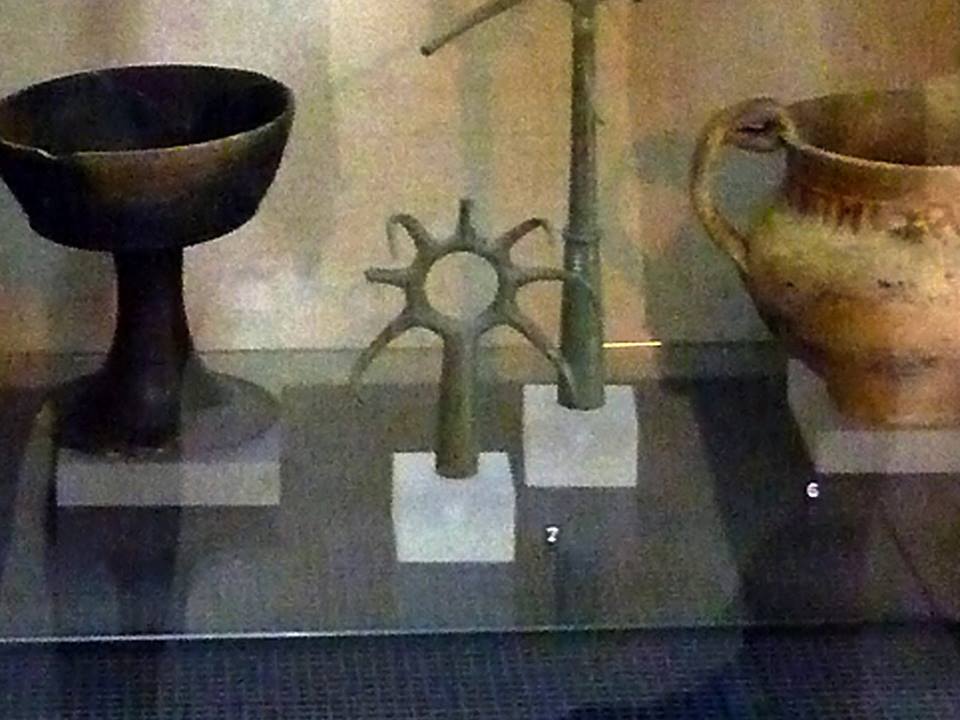
Pansa Collection, Archaeological Museum of Abruzzo, Chieti
The Pansa Collection was bequeathed to the National Museum at the wish of Giovanni Pansa, a lawyer from Sulmona and a great collector of antiquities. Unfortunately, many of the finds that entered the collection are, as in this case, without any context data: it is therefore not even certain that the find comes from Abruzzo.